On viewFree
Marc ChagallCentre Pompidou Hanwha, Gallery 1
Chagall, Ever Crossing
샤갈, 너머의 여정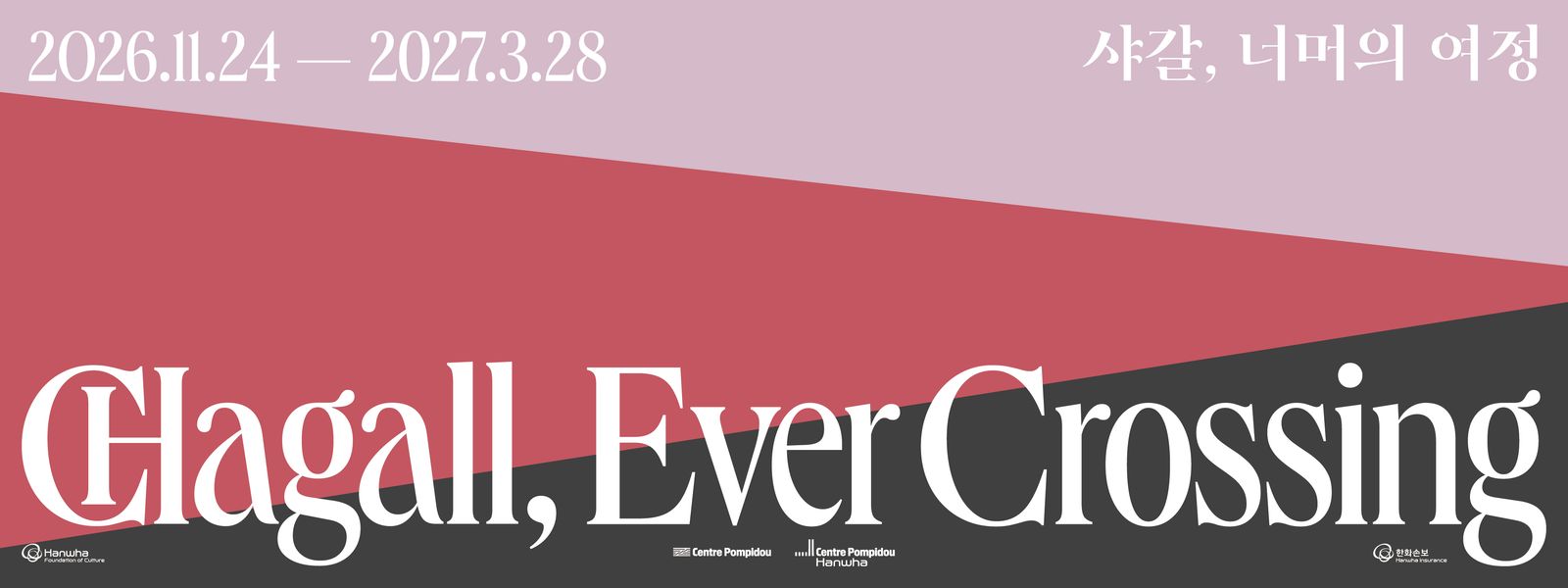
About the exhibition
Chagall, Ever Crossing brings about 65 works by Marc Chagall (1887–1985) from the Centre Pompidou in Paris: paintings, sculptures and ceramics made between the 1900s and the 1970s. It is the second exhibition Centre Pompidou Hanwha has organised with its Paris partner. The Pompidou's Chagall collection was built largely through gifts from the artist's family.
The museum frames the show around how Chagall's art kept changing through the upheavals he lived through: from Vitebsk to Paris, back to revolutionary Russia, into wartime exile in the United States and finally to the south of France. Alongside the paintings are sculptures and ceramics rarely shown in Korea, reproductions of his stained glass and a film of his ceiling for the Paris Opera. Together they show how his work spread beyond painting into other media and architecture.
About the artist
Marc Chagall (1887–1985) was born near Vitebsk, then part of the Russian Empire and now in Belarus. He trained with Yudel Pen in Vitebsk and studied in Saint Petersburg. He moved to Paris in 1911, where contact with Cubism and Fauvism shaped his colour and forms, and he showed at the Salon des Indépendants from 1912. The First World War kept him in Russia, where he married Bella Rosenfeld and took part in the Vitebsk art school after the 1917 Revolution. He settled in Paris in 1923. The Nazis labelled him a "degenerate" artist; he became a French citizen and in 1941 went into exile in the United States. After the war he returned to France, and he died at Saint-Paul-de-Vence in 1985.
Sources: Centre Pompidou